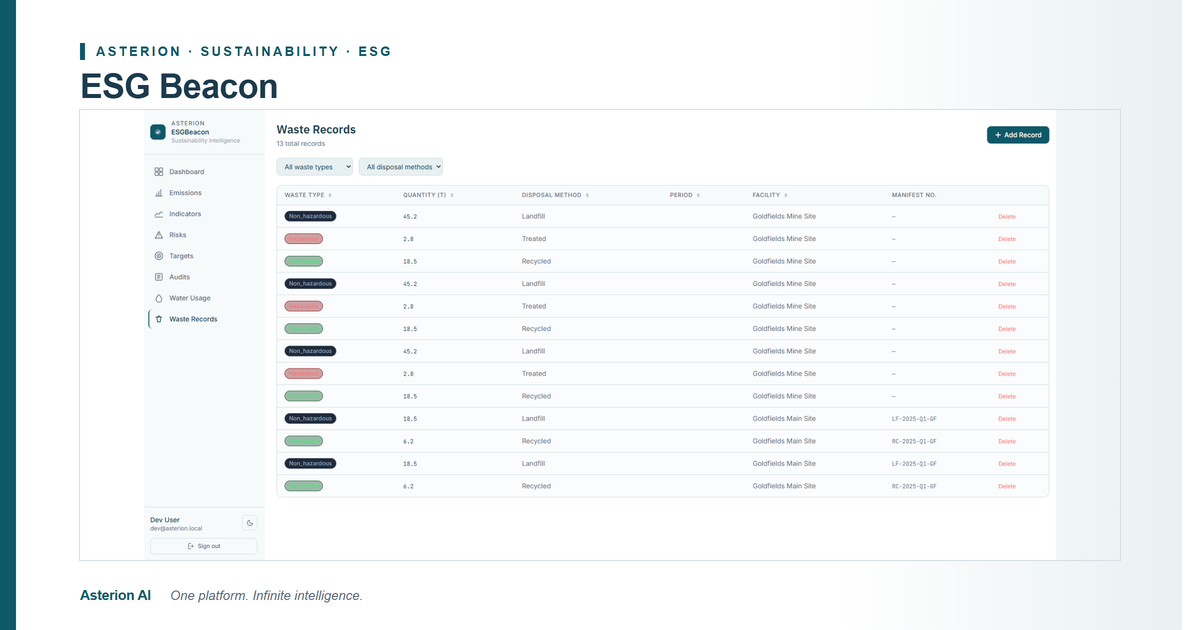
ESG data pulled together from across the operation, for structured reporting, investor disclosure and regulatory compliance.
Download the product overview (PDF)
Demands are increasing from investors, regulators and customers further up the supply chain. The difficulty is rarely the report itself. It's that the underlying data sits in dozens of systems, mostly unvalidated, and pulling it together by hand produces metrics that don't reconcile.
ESG data lives across dozens of systems, unvalidated and hard to reach when the deadline arrives.
Inconsistent metrics and unverified numbers create real regulatory and reputational exposure.
Manual aggregation stretches the reporting cycle long past the point where anyone trusts it.
A built-in carbon engine with emission-factor tables, energy-to-CO2e conversion and Scope 1, 2 and 3 methodology. The footprint is computed from operational records rather than stored as a self-reported total, and energy data populates from AssetVault through the shared data layer.
Consumption tracking, discharge monitoring and waste classification, with alerts against regulatory thresholds.
Workforce diversity, community engagement and social investment tracked against the frameworks you report under.
Board composition, ethics programme monitoring and policy compliance status across the organisation.
A mapping engine links each GRI, SASB, TCFD and CDP requirement to the metrics you actually collect, flags the gaps, and generates audit-ready reports per framework.
Target progress and forecasts computed from reconciled operational data, including safety events from SHREQ360, so the numbers shown to investors match the numbers run on site.
Global Reporting Initiative Standards
Sustainability Accounting Standards Board
Task Force on Climate-Related Financial Disclosures
Carbon Disclosure Project
International Finance Corporation Sustainability Framework
United Nations Sustainable Development Goals
Safety incidents, environmental data and compliance metrics flow into reporting instead of being collected again for it.
Workforce diversity, training hours and labour practice data feed the social side of the report.
Asset energy consumption aggregates into environmental performance without a separate data-gathering exercise.
Own strategy and stakeholder reporting across the organisation.
Track emissions, energy, water and waste against regulatory thresholds.
Produce framework-aligned disclosures for investors, analysts and rating agencies.
Watch ESG performance at enterprise level, with the trend rather than a point-in-time number.
We look at where your data comes from, how mature the reporting is, and how well it lines up with the frameworks you're disclosing against. The gaps are usually in the source data rather than in the report.
Numbers that reconcile to the operation.
Regulatory environment and stakeholder expectations change what has to be reported.
Data gaps, reporting readiness and disclosure risk, stated plainly.
What happens from day one, agreed before anyone starts.
 ESG BEACON · ESG GOVERNANCE